
Part 1 of 3 — The problem with two-dimensional risk assessment

This is Part 1 of a three-part series. Read Part 2 and Part 3.
22 January 2016
I'm sure that many of us in the world of aviation Ops have seen a Risk Assessment matrix in a form similar to the one below (from ICAO Doc 9859, 4th edition, 2018):
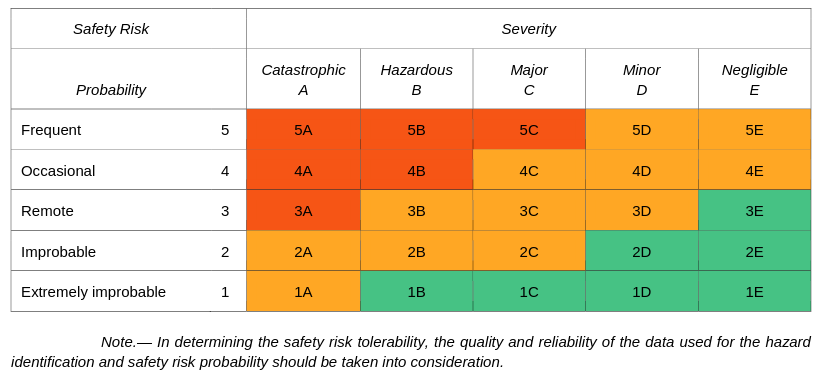
Sometimes it's formatted differently, sometimes it's a 4 x 4 matrix rather than 5 x 5 but the concept remains consistent. We have two dimensions, Likelihood (otherwise labelled as Probability) and Severity (otherwise labelled as Consequence) represented on two axes. Somehow, using our best prognostiscope, we mash the two together and come up with a Risk Rating.
That's mathematically fine and in fact very sensible as a management tool. It tells us about the rating of any single event and whether it's within our 'acceptable range' of operational risk or whether risk mitigation needs to be considered.
However, my contention is that this isn't adequate for executive understanding of the 'Whole of Organisation' operational risk level. Sure, using the risk matrix approach we've quantified the 'known unknowns' of an individual operation. However, until we account for the frequency of that individual operation, we are looking at a factor or a rate not a quantity. To understand the Whole of Organisation risk arising from planned operations, we need to add the third factor, frequency, to our risk matrix.
Representing three-dimensional matrices on a two-dimensional screen isn't as easy as it might seem when said quickly, so in the next instalment I'll try to explain in words what that three-dimensional matrix might mean.
Until then, feel free to disagree with me. Scientific method isn't about consensus, it's actually about dissent; the more, the better.
If three-dimensional risk classification is relevant to your organisation, I'd welcome the conversation.
Get in Touch